Saturday, May 11, 2013

Deh Spice Necklace .....Memories of Grenada


In the outdoor market in Grenada's capital St. George's, women sit holding long, fragrant strands of the island's spices out to passersby.  "Hey darlin,  you want a spice necklace...I give you good deal?"  It is hard to pass without breathing in their scent and eventually succumbing to buying some.  They are made up of a little of everything on this spice island...nutmegs, hidden in polished mahogany shells under lacy scarlet corsets of mace,  spiky, pungent cloves, slices of saffron-coloured turmeric root and chunks of pale-gold ginger, rough curls of cinnamon bark, cocoa beans, fermented and roasted to a deep chocoate-brown, bay leaves, folded into tidy squares that give off a whiff of balsam forest, small dark disks of tonka bean, which look like exotic beads and smell like vanilla and then to fill the spaces between the spices are strings of egg-shaped ivory river seeds. " Once dey not smell so much, place deh necklace in warm water for five minutes and deh smells...dey comin back!"

This winter in Grenada was a nice balance of boat work and new adventures.  We thoroughly enjoyed our trip north to Bequia and exploring the Tobago Cays.  We were happy to get some work done on the big girl as it had been awhile since we had had the time or the conditions to do more than fix things as they broke down.


Our haul out went well and Celebrian is in a more permanent spot this year and shouldn't have to be moved.

The first thing that we needed to do was scrape the barnacles and critters off her bottom.  We knew it was pushing it not to do bottom paint this year but we decided that with the short season we could leave it for another season.  She was quite the sight when she was lifted out and it took both of us scraping for two hours to get her clean.  The tropical water at its 28 degrees C (86F) sure grows things.  Next season we will doing bottom paint for sure.

In the evening at Cool Runnings the captain was working on his glue projects....a cover for the hatch cover to protect the varnish and his sandals which have had numerous previous glue jobs.  Yes...those are granola bars holding the sandals?!?!?
We had our farewell dinner with our friends Dennis and Arlene on Tiger Lily 2 and John and Katherine on Katerina at De Big Fish Restaurant by the boatyard. 
The captain does a terrific job of battening down all of things that could blow in strong winds. One half of our nesting dinghy Goldberry fits over the forward hatch and allows it to be left open for ventilation.  The other half protects the skylight.  Rob's new sunbrella cover proved to be a good fit and we hope that it will stay attached and protect the new varnish over the summer. 
A sure sign of spring when we arrived at the cottage are the trilliums in their full spring glory.
The first day that we were home we were anxious to get out to the cottage and check on how things had come through the winter.  The weather was so inviting that we decided to move into the cottage instead of the condo.  Of course we knew it wasn't going to last and we now have the stove going; however for several days it could have been Grenada? 
Well.....maybe not quite Grenada, but pretty darn nice for Lake Huron in early May?

Wednesday, May 8, 2013

Home Sweet Grenada


Today is Tuesday April 23rd and we are anchored once again in our favourite harbour boat yard of Port Egmont.  It certainly is more pleasant working on the boat here than in the heat of the boat yard.

We had one of our best sails from Carriacou the other day.  We anchored off of St. George's and then moved around to our favourite south Grenada harbour.  Here we will stay until we go to Prickly Bay on Sunday to be ready for a Monday 8am haul out at Spice Island Marine Services.  We will have a busy four days in the boat yard removing and re- greasing our anchor windless, working on the wheel brake, pulling out our hot water tank that seems to be leaking, re-bedding our forward hatch, scraping the bottom, and let's not forget making love to the batteries along with a multitude of other jobs.  Then there is the usual bleach cleaning of the lockers in order to prevent mildew and the laundering of everything on the boat. We have three out of the four nights in the yard booked for Cool Runnings so I will have ample time to get our laundry done.

This picture shows Rob with our forward hatch which he had to remove and re-bed.  This hatch is over our berth.  Recently it has rained more and I have been experiencing a kind of Chinese torture of drips in through the hatch.  It is a key hatch not only for the prevention of fresh water but it takes the brunt of salt water as well.  Since putting it back in I am happy to say we have been staying high and dry.

These pictures show me doing provision inventory and cleaning.

  Since so many of our goods are stored out of sight it is important to keep good notes on what we have.  Sometimes we just reach in to a locker and see what we pull out and that is the vegetable of the day.

On our last bus trip to St. George's I stopped at White Cane Industries to pick up a tray that we had made for the cottage.  White Cane Industries, originally known as the Blind shop, was opened in June 1960 by a social worker who trained blind and visually-impaired persons in basket weaving.   In 1990 , the name was changed to White Cane Industries and over the years it has expanded to weaving of cane and straw baskets, trays, purses, mats and frames.  It is White Cane's aim to provide persons with physical and intellectual/developmental disabilites in Grenada with essential independence skills as well as vocational training.

 As you can see from the picture the people who work here enjoy what they do.

Finding clothing that is comfortable and light enough for this climate is a challenge.  Most everything in the stores here is acrylic or polyester and there is not a cotton item to be found.  Gratefully I found a tiny shop selling one hundred per cent cotton batik wear made on the premises.

This picture shows the first stages of mixing the dyes.

Upstairs these ladies were tracing out the pictures in a wax outline.  Many of the designs are free form but there are also patterns of tropical fishes and turtles.

This lady was making a cushion cover from the ends of colourful fabric.  
The dress with its designs of fish and turtles.....practical and a lovely reminder of our winter in Celebrian's home sweet Grenada.
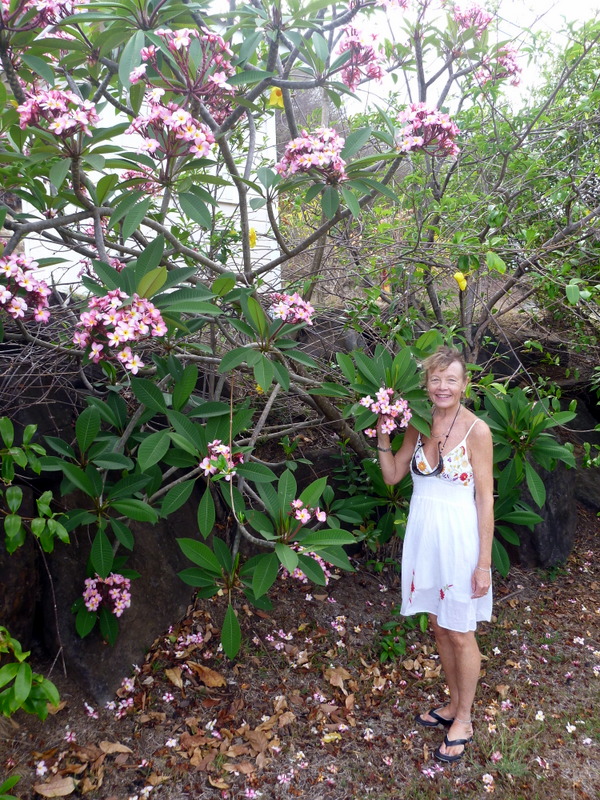
 Every once in awhile you have to stop and smell the frangiapani.

Monday, April 29, 2013

Deh Leatherback Turtles Done Reach Grenada

 This time of year in Grenada giant leatherback turtles come ashore to lay their eggs on the northern remote windward beaches.  The cruisers organize evening tours to the beaches with a local taxi driver named Cuddy.   The small groups are met by researchers who are studying the turtles and working on conservation programs.  They take you out to the beaches in the dark when the females come ashore.  It sounded like a wonderful tour to take.

The leatherback turtles are true giants.  They are the largest of all marine turtles and the heaviest reptiles in the world.  Their very distinctive shells have a leathery appearance and are often close to 8 feet long and weighing up to 2000 pounds.  It is thought that the leatherback's bulk enables it to maintain its body temperature that allows it to swim into more temperate waters than any other turtle.  Leatherbacks are apparently unaffected by sea temperatures even below 5 degrees C (41F) and they range as far north as the seas around Alaska.  They are also found in the oceans off the Chilean coast as well as close to New Zealand.  There is some concern that global warming may be affecting the range of these turtles because every once in awhile a turtle is found stranded on a beach far from the tropics.

Leatherbacks return to the tropics to breed.  The females return to the beach where they were born to lay their own eggs.  It is thought that the female leatherback, after she has completed the task of egg laying, circles the nest site, just as the young do once they hatch.  It may be that this behaviour somehow imprints onto the memories of the youngersters , aiding their return to the same place.    They try to find remote beaches which they can haul themselves up onto without difficulty and where they can come directly out of the deep seas rather than swimming over reefs.  Although they lay eggs on their own, they sometimes nest in small groups especially where there is an ideal beach.  The females come ashore every two to three years and typically lay 6-9 clutches per season.  Each of the clutches consist of about 80 viable eggs; however only about one of those turtles lives to the age of 20.  Even though the turtles are programmed to dig themselves out at night there are still lots of predators around to snatch them up before they reach the sea.  Of course once in the sea a 2.5 inch turtle makes a nice snack for just about anything?  Even once they are full grown they face a number of predatore such as various sharks and killer whales.

In addition they face continued problems being caught in fishing nets and swallowing plastic bags and other refuse that looks like their almost exclusive food jelly fish.  Fishermen are being educated to use devices to keep turtles out of their nets but there is still a long way to go.   Leatherbacks are on the critically endangered list and considering that they have been around for 150 million years it would be a travesty if such an incredible creature became extinct.

After almost a two hour bus ride up to Levera Beach we were met by Leticia, our guide for the evening.  She gave us an overview of the program and the dos and don'ts of turtle watching.  The researchers and scientific team are working hard to maintain the numbers of leatherbacks that visit Grenada to lay their eggs and are out on the beaches each and every night during the season.  Part of the cost of our tour to Levera was a donation to help the researchers continue in their efforts to save these amazing reptiles.

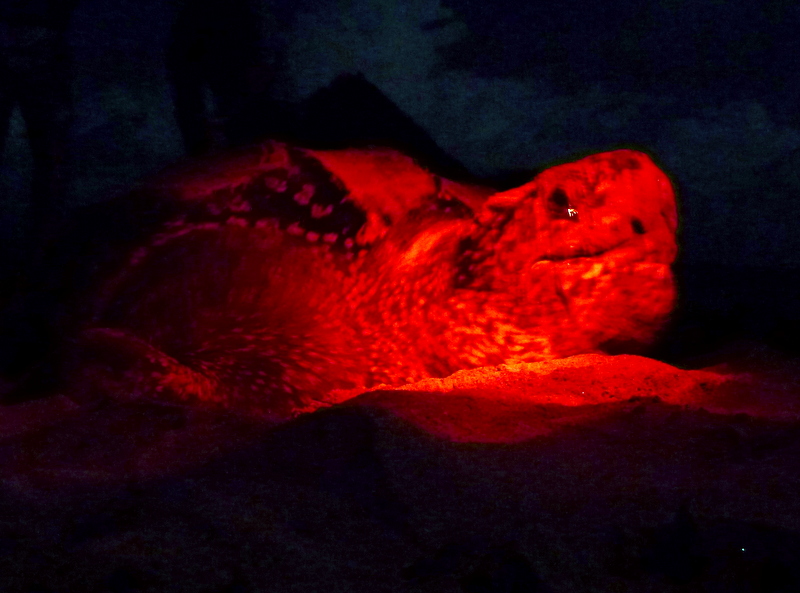
From the station we were taken out to the beach to wait. The most recent group had had to wait until 11pm before a turtle came ashore.   No sooner had we walked onto the sandy full moon lit beach than we saw the shadows of something large along the shore.   We had to keep our distance initially but we watched in awe as this 1500 pound creature crawled up and over a berm of sand.  It was obviously a supreme effort for her.  When she was content with her nest spot she began to use her rear flippers alternately to dig a hole.  She digs until her flipper can no longer reach the bottom of the hole.  Once she was digging we were allowed to stand behind her.  Only red lights are used as turtles can not see colours. Fortunately we also had a full moon which allowed us even better viewing.


Once her hole is dug the researchers place a rope in the clutch so that they can find the eggs again.  Often they have to move them further up the beach if they are in danger of being undermined by the sea.  When she is laying she goes into a kind of trance and is less aware of what is going on around her. They lay about 80 large viable eggs and another 40 or so small eggs that provide hydration for the hatchlings.

 After she was done and still calm we were  given an opportunity to touch her shell as well as her flippers.  The shell is quite leathery and can stand the pressure in deep water. By compressing it allows them to dive to extreme depths of upwards of five thousand feet in search of jelly fish.  We thought the flippers would be hard but they felt like sponges.

After she finished laying she used her back flippers to fill in the hole and her front flippers to begin camouflaging the area.  This process took a good hour and a great deal of effort on her part.  You could hear her puffing at times and before she was through the area looked like a small bobcat had been working in the sand.

  And true to the information that I read she did in fact go in a circle.  Once she was finished it was time to move back and let her focus on returning to the ocean.  It was a very moving sight watching this huge creature return to the sea. All in all the whole process had taken about two and a half hours.  Before we left the beach two more turtles had climbed out on to the beach and the second research team around in the next bay reported that they had five turtles.

What a once in a lift time experience it had been!  We felt very honoured and humbled to have been given the opportunity to witness one of nature's amazing spectacles. Let us hope that these amazing turtles are around for another 150 million years.  
In this picture you can see the ridges on her back that allow the leathery shell to contract with the water pressure.  You might also notice in some of our pictures that the turtle looks like she is crying.  This is the way that sea creatures deal with the extra salt in their bodies and whether she is in the ocean or on land her body  is giving off  the salt that she doesn't need in this manner.  

Tuesday, April 23, 2013

For Deh Love of Boats


The Caribbean is a place of boats....work boats, race boats, cruising boats, fishing boats, sailing boats, powerboats, row boats, cruise ships, and more.  Some are made of steel, others fibreglass and most of the local boats are made of wood.  Some are made in factories, some are built by do it your selfers and many of the locals have the skills to build their own traditional wooden boats.  Some are big, some are small and some are incredibly huge.  What they all have in common is that they are central to the lives of the people of the Caribbean, both those of us who just are passing through and those people that make their living from the sea. I believe that is why the Caribbean holds so many regattas.  The racing events are a celebration of boats as well as the skills of the people who sail them.  Boats are revered on these island and in most cases very well looked after.

 The following is a pictorial celebration of boats of the windward islands from Bequia in The Grenadines to Grenada.

This schooner came into Chatham Bay, Union Island to say hello to the English boat next to us.

This wooden sail boat is a working boat in the village of Ashton, Union Island.

These fishing boats were along the waterfront in Ashton.

These wooden boats in Petit Martinique are at the ready for fishing.

The next two pictures show wooden fishing boats made in Petit Martinique and kept on moorings.  The colours of blue and orange are a favourite in the Caribbean.

 
This wooden schooner from Bequia takes passengers on day trips.

This is the catamaran Black Swan that anchored beside us in the Tobago Cays and made us feel small.  Notice the size of the crew on deck.

This large power boat was another big visitor to the popular Tobago Cays anchorage. The tender beside it is almost as long as Celebrian and probably worth several hundred thousand dollars?!

Another beautiful schooner visits the Tobago Cays.

The clipper ship line is a popular way to cruise The Grenadines.   Certainly if you enjoy sailing and living in luxury this ship is the way to travel.  The best of both worlds ....a boat that can sail well and the comfort of a cruise ship.  Of all the larger sailing cruise ships that we saw we liked the clipper the best.  She was rigged to sail and not just pretend to sail.

Local working boats in Bequia.

In Bequia there is a floating diesel and water boat available.  Bequia was very yachty and lots of services were available for cruisers...diesel or water delivered to the boat, the usual bread and fish and my favourite...Daffodil's Laundry Service.

 Bequia race boats out for a practice.

The clipper ship stopped in Bequia while we were there.  What a great sight it was to see it as the sun went down and its lights came on.

You can buy hand made wooden ships in Bequia.  This was a beauty and priced close to a thousand US.

Many of the smaller race boats at the Bequia Regatta had obvious sponsorship.  Their crews were young people from the French islands as well as Barbados.

This beautiful wooden race boat was from Petit Saint Vincent and was racing in Bequia.

This monohall was one of the larger single hull boats we were anchored nearby.  Once again notice the size of the crew on deck to get perspective.

Launching one of the 28 foot wooden double enders in Bequia.

Carriacou has a long tradition of boat building.

Three beautiful wooden boats built in Carriacou and anchored off of Windward, Carriacou.

This is a floating welding and aluminum shop anchored in Tyrell Bay, Carriacou.

Several days a week there are cruise ships anchored off of St. George's, Grenada.


Goldberry is our family car and gets almost daily use whether its going to shore for chores or pleasure.  She also provides water scaffolding for the captain when he is varnishing.

Our favourite boat and the one we love deh most....Celebrian.